23 November 2016

The ABC's in BCBA Order

From our anchorage, Aruba was highly developed with hotels and casinos.  We only stayed two nights.

Milly in Bonaire.  Definitely one of the top islands on our list.

Curacao was really all about this view.  The charm was limited to a few blocks.  Our fun was mainly due to our great companions.
A for Aruba
B for Bonaire
C for Curacao
from east to west and, hence, the natural order of arrival for us - Bonaire, Curacao, Aruba.  Hurricane Matthew confused our voyaging.
Oh, so dry!
It was a bit of a shocker to arrive in Bonaire in the Dutch Antilles after spending the season in the hilly, lush coasts of the Lesser Antilles.  Bonaire is a desert.  Prickly, tall cacti are the most common plants in dry, sandy soil.  Scrub being the only other greenery, not counting the irrigated plants in gardens and pots.  It is not beautiful land but the pace was easy and comfortable, the Dutch provisioning varied and new to us - always fun.  And the nature, both on land and especially in the water, was superb!
Wild donkeys roam the island. Not sure what they find to eat.  

Can't be a Dutch island without windmills.  There were a few but it makes sense that there should be many.  Solar panels and wind energy would surely provide enough energy for the population but apparently politics keeps diesel generators the power source of choice.

Flamingos in the wild.  I've only seen them in the zoo or on lawns.  Did you know they are pink from eating shrimp??

Swimming flamingos.

Iguanas are a dime a dozen. 

On the top of the highest peak, we were joined while snacking by this couple.  The male was gorgeously coloured compared to his plain Jane partner 

Peter and I biked to the donkey sanctuary where they keep the old, the mums and babes, and the hungry and ill donkeys.  We took this pic from a watch tower.  Getting there we were greeted by ten's of these soft eyed creatures looking for a hand out.

A fuzzy headed babe.  So cute!

Fences are made of the most abundant plant life - cacti.  I imagine they protect the land inside pretty well.

We hung out with many other cruisers, renting scooters one day and a truck the next to explore the land and diving from the back of a boat to explore the depths.  For Wednesday burger nights we commandeered the restaurant with numbers in the high teens and would often get together for drinks and munchies after hot days spent mostly in the water.  We celebrated birthdays and anniversaries, went on a hash provided solely for us and hiked to the highest peak - as per usual, kayaked in mangroves, snorkelled and beachcombed.  The men took kiteboarding lessons.  Peter is now hankering for a kite.
Scooter tour around the island. Hippie van with boards parked for years outside an equally flower-power windsurfing bar.

The bar and the sensationally coloured lagoon.

Slave huts the size of doghouses for four or five slaves to sleep in after working all day in the salt flats.  Blazing hot sun!  No ventilation other than a door that is no more than a meter high.  Can't imagine! Human-to-human cruelty is always shocking.

Kiteboarding set up.  No pics of Peter taking lessons - I didn't go.  The women went beach combing instead.

Salt flats.  The huge pans of water become pink, reportedly from algae.  The mounds of salt were much higher than the highest building on the island.  We picked up big crystals of salt under the conveyor belt that carried it to the ships.  The salt pier was our favourite diving site - a huge variety of fish, octopi, eels hung out around the pilings in enormous numbers and crystal clear water.

A tiny, neat distillery that used cacti as it's base, creating liqueurs and liquors. 

Cacti liquor.  
After one year in the hold, we finally got the bikes out.  Our first, longer and, hence, hotter then expected ride was to the wild and desolate east side of the island with very rough off-roading.  In the background is an old, abandoned plantation house, not quite as affluent as those in Barbados, for example.  The main crop on this sun bleached island is aloe.

Barren and beautiful?

Trees do not grow high, they grow long - hampered by the wind.   A lesson in tenacity.

The shoreline was littered with these.  Yikes!  The power of the ocean demonstrated once again.

Birthday ride for me, followed by a dive and then a party on Livin' Life.  Happy times!


Even the cacti look withered and dried out

Hike up to the tallest peak - about 660 feet.

At the top.

Picking our way down.

A hike to another peak.  Everything in Bonaire was a hot and sweaty - as you can see - affair.

A deep, dark cave.  A ladder down was the only mark by man.  Otherwise we edged our way deep into the hillside with headlamps until the air became too damp and oxygen deficient to go any further.
Our time in Bonaire was interrupted by the threat of Tropical Storm Matthew.  The ABC’s are lie  south and west of the hurricane belt and so, of course, we thought they were a safe addition to our sail plan even during the month of September - reportedly the most common month for developing storms.  

We had only been in Bonaire a week when Matthew reared his head.  Monday morning saw a line up at the marina office with owners of boats in the mooring field hoping to find space at the dock.  Apart from the moorings being on pathetically small lines, Matthew was expected to bring west winds as it passed by meaning that the boats in the field could be driven on shore - never good for a boats bottom!  There was no room at the marina for catamarans so we left Bonaire prematurely for a sheltered marina in Curacao along with two other cats and one monohull we had been spending time with.

We stayed in Curacao for a week.  We prepared Milly by tying her securely to the dock, bringing in stuff that could blow around from the deck, making sure her sails were secure and putting up the enclosure.  By this time Matthew was deviating northward and Curacao was no longer in his path.  The day he passed was blustery with a thunderstorm but nothing untoward.  As he passed, he became a hurricane and considering the fallout that lasted over a week in the ABC’s and consisted of rough seas and west wind, we were very glad that Matthew was a nonevent as he passed us by.

Curacao was also a bit of a nonevent.  The marina was so isolated that eight of us rented two cars to get around.  The roads were busy and lined with the Caribbean equivalent of big box stores.  We went on two pleasant hikes, one dive and explored the capital, Willemstad, which was charming.  No need to return though.
The floating market in Willemstad.  The Venezuelan boats line the canal and sell their fruits and veg from booths on the land side while living in their boats.  This came to an end shortly after we left the island.  The president of Venezuela made it illegal for boats to go to the ABC's to sell when the Venezuelan people are starving.

Great thrones for the captain and first mate outside an equally fantastic bar.

Steve, our hike leader in Grenada, lead us on another hike in Curacao the day Matthew arrived.  Thunder and lightning didn't stop us from attempting to scale the highest peak near the marina which happened to have an open pit mine on it.  No paths, just bush whacking through the prickles.  We made it to a plateau just below the peak before the rain started bringing down the soft earth strewn with boulders.  I had visions of headlines - "Four cruisers die in avalanche".  We are still safe and sound and lived to tell the tale.

The day after Matthew - a hike to a smaller peak on a path through a golf course!  Overlooking the marina where Milly was staying with the open mine peak in the background.

The slave museum in Curacao was excellent but, again, disturbing cruelty.

Back to Bonaire for more superb diving.  We did two night dives and several boat dives.  Livin’ Life proved the perfect dive sailboat - she has a large platform at the back where we could line up twelve tanks plus equipment.  Janice and Dave generously took us all out to various sites several times, followed by sushi with freshly caught tuna.  No wonder we stayed so long.
Our tradition became feasting on homemade sushi featuring boat-caught tuna after an afternoon dive.  Delicious!  Life is good.

We had heard there were a couple of seahorses that hung out near our boat.  Not easy to spy in the coral rubble but many snorkelling trips later, Leslie, found this guy.  He/she was our first seahorse.  They look totally inflexible apart from the tail which hangs on to the rubble.  When they move which is not very frequent, they kind of coast along the bottom using the tail to push along, while not changing the position of the head at all.  Strange creatures.

We took a kayak and snorkelling tour through the mangroves.  Beautiful.

This heron was fishing as we swam by.

There was quite a current that swept us down a mangrove tunnel where the coral was colourful and the fish hung out in the roots.  Returning the same way was good exercise.  No flippers allowed.

A recovering boobie has become a comfortable pet.  We have seen lots of boobies on flight from the boat.  
Finally, we tore ourselves away from Bonaire to sail with Livin’ Life and Slow Flight to Aruba.  We had been told to give Aruba a pass - highly developed with hotels and duty-free shopping.  However, we were all curious and it did have an anchorage with a great kiteboarding reputation.  So off we went.

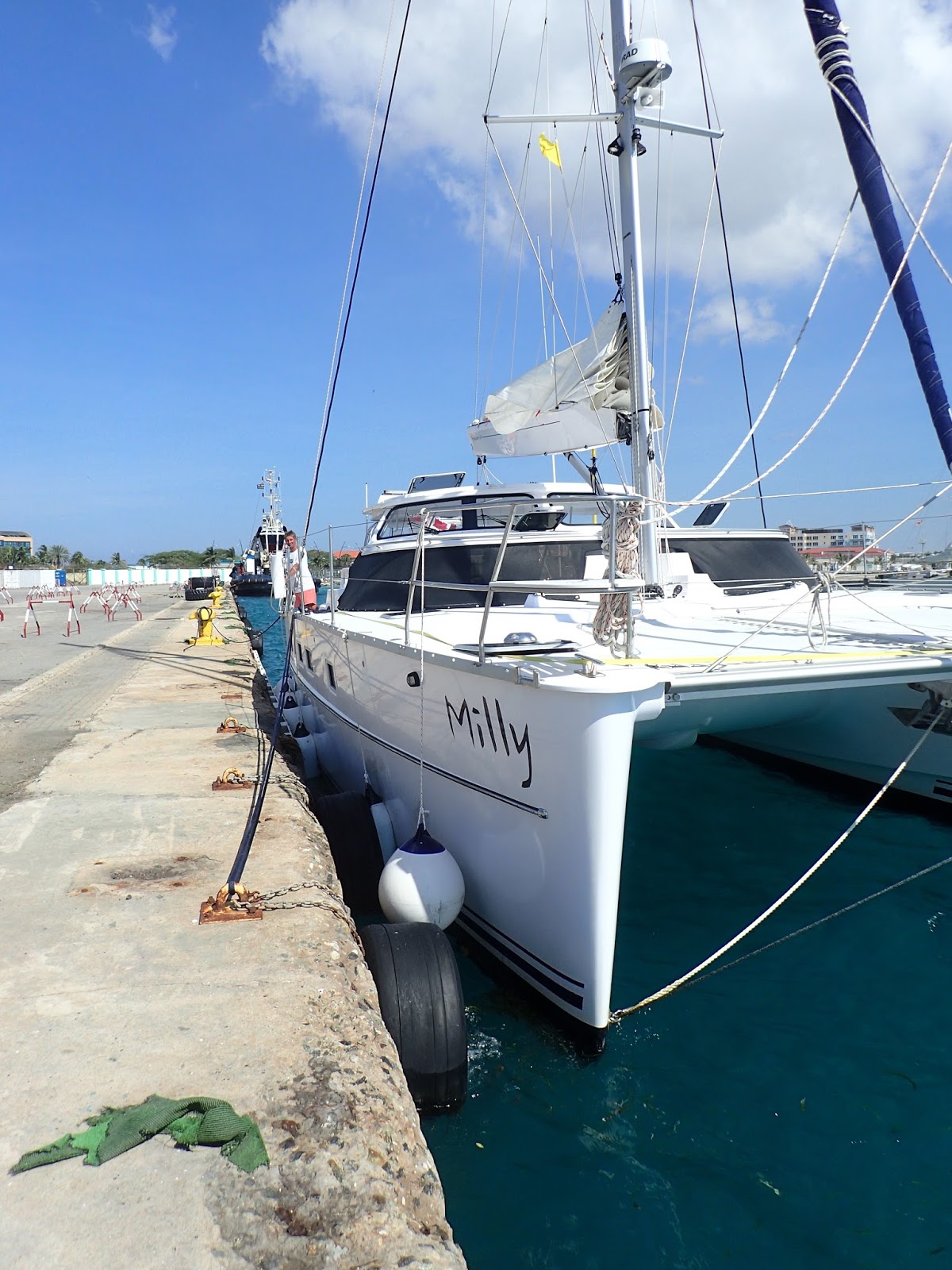
We knew immediately that the island was not set up for cruisers - they made enough money from cruise ships and landlubbers.  We had to dock at an enormous cement dock designed for tugboats of which there were many.  The wind was high and the waves were higher as Peter edged in to the rough cement block with huge black tires and the end of rebars sticking out.  The port captain and customs officials were waiting in cars to hand us various papers but no one stepped out to give me a hand with the lines.  Instead, I was forced to perform an absolute no-no - I leapt from the heaving boat to the quay with the line trying to tie it up while keeping Milly off the cement.  A bunch of guys working on the quay that had been badly damaged by the leftover waves of Matthew, finally came to help and added their strength to holding Milly away.  Paperwork was delivered to us so we didn’t have to leave Milly who was being battered and smudged by the black tires but the officials, immigration in one car and customs in another, had to drive away to their offices to copy and stamp.  Very strange set up - one that might be fine on a day of less wind and waves but highly irritating and stressful at the time we needed to do it.  Luckily, Peter’s deft driving left Milly unscathed apart from big black smudges on her freeboard.  We were followed by Livin’ Life and Slow Flight who also had multiple problems with little help offered in managing their boats even though Steve was solo.  Not a great introduction to the island.

The infamous dock.  This picture does not do the experience any justice at all.  Looks quite pleasant - just the opposite....

...as you can see from the captain's expression.  The blue sky deceives you.  I should have taken a video of the boat's movement instead.

Aruba lived up to it’s reputation - built up beaches, blistering sun, little nature to explore, a contrived town full of North American duty free shops and not enough wind to kiteboard.  We agreed - we would advise giving it a pass.
Waiting for the wind in Curacao.  Never appeared.  Time to sail on!
It was time to leave the Caribbean and head to South America.

9 November 2016

Passage Firsts


Photographer Janice on Livin' Life took this on Aruba to Cabo de la Vela passage.  Great travelling with buddy boats!

We have made several short passages of late:  Carriacou to Bonaire (4 days), Bonaire to Curicao (to find safe harbour from Hurricane Matthew) Curicao back to Bonaire (for more diving), Bonaire to Aruba, Aruba to Cabo de la Vela, Columbia and Cabo do la Vela to Santa Marta.

For us, passage-making is never dull.  Peter and I enjoy the solitude and beauty of the vast blue.  The movement for our recent passages has been easy and comfortable - mainly downwind or no wind.  Going with the wind means we are surfing any waves that happen to be on our stern which boosts are speed without a roll or, worse, the pound of upwind.  No wind means we motor sail at best or motor sans sails which is aggravating but easy.
Downwind, we put out as much sail as wind speed allows.  We've found that two head sails wing-on-wing moves us along more easily than head sail and main.
We have seen plenty of lightning on these last passages sometimes sending me scurrying around to pack our mobile electronics in the “faraday cage”/oven.  But all has been for not.  So far, so good.

Our 3 day passage from Carriacou to Bonaire was pretty great.  Wind was light and on our stern so we were able to fly our spinnaker for a record 29 hours.  We have previously been more conservative with our sail plan overnight but the moon was so bright and the sky so clear that we thought we’d go for a couple of knots extra speed.  The difficulty with the spinnaker at night is that it requires two to bring it down with a bit of finesse and visuals.  With a full moon, the visuals were okay but it’s always takes more time when one of us is roused from a short sleep, groggy and plodding.  If the weather turns for the worse, the extra time the douse takes is a bit risky.  However, on this passage there was no need for hastey action and we slipped along through the waves without concern.
Spinnaker and screecher

Our happy spinnaker is beautiful against the blue sky and sea.  At least, I think so.

During the days we saw several barn swallows buzz the boat, swooping around and then flying off to who knows where - no land in sight.  There were usually a few together.  One evening a little guy kept me company periodically, perching on the windshield and lifeline.  Peter had the same companion but this time the nervey little guy came right into the saloon and perched on the TV we never watch.  Peter swished him out but he was determined to keep us company, obviously pooped.  Over the day, we made a point of keeping quiet so as not to scare him. I attempted to give him water but he turned his back on it.  With time it was obvious that he was suffering and gradually he flopped with wings spread.  Our first stowaway very sadly became our first burial at sea.  We learned later that other boats travelling at the same time, also spotted the swallows.  We seemed to have been on their migratory path.  I hope where they were going was worth the trip because it sure was a perilous journey.
Our little stowaway on the 3 day passage rested on various perches out of the wind.


Not particularly welcome inside the saloon.


Sad end.

And we finally caught our first fish.  We only occasionally put out our lines but lately we have spent time with cruising fishers or fishing cruisers.  I put out our hand line - no rod or reel, just a line that we put in almost as soon as we set sail for Cabo de la Vela.  By afternoon, not a bite.  I was just settling down to attempt a nap and Peter casually announced that there was something on my line.  He pulled it in with ease to find a 26” tuna.  After some mucking about, not quite sure what to do, he landed the guy, I doused him with cheap rum, Peter filleted and I cleaned and bagged the meat.  It is now in our freezer awaiting purchase of some sushi ingredients.
Tunas have huge beseeching eyes.  A bit guilt inducing, actually.

On the same passage, our friends on Livin’Life caught a tuna or two and a four and a half foot wahoo which they filleted in their dinghy!  Once anchored we all had wahoo for dinner.

Another first: sailing with buddy boats.  For four of our passages we sailed with Livin’Life and Slow Flight.  It feels a little cozier at night to see other tricolour lights twinkling with occasional VHF chatter and updates.  And when we got into harbour, we enjoyed the product of their fishing labours.
Buddy boat "Slow Flight" with pelican perched on pulpit.

"Livin' Life" always great company at sea and on land. 

And finally, a not so fun first.  On our passage from Aruba to Columbia, we had pretty constant lightning to the south of us, sticking to shore.  But a very large black cloud also showed us four water spouts (tornados over water).  One was long enough to raise the water as it neared the sea’s surface.  It was intimidating enough that we quickly doused our spinnaker, took loose stuff in the cockpit inside and put a couple of panels of our enclosure up.  The spouts gradually disappeared but not before giving us a few anxious moments.
This cloud produced four water spouts.  We were too busy securing the boat to take pictures of the other three. We could see the water being drawn up off the sea surface under this one.  Just like tornadoes, it is impossible to predict which direction these ominous things will go.

Views of the coast as we are approaching new lands are always exciting.  Columbia ranged from desert to green mountains and, a first in the Caribbean, a view of a distant snow-capped! mountain range.
Taken at sunrise, the snow capped mountains of the Sierra Nevada de Santa Marta are on the left side, very faintly in the background.  Who knew you could see snow from a boat in the Caribbean Sea!

Although it was not our first but always exciting, we had large pods of dolphins playing at our bow.  On three different passages, we had striped, spotted and common bottlenose dolphins keeping us company.  Striped are quite small, spotted are very frisky and the bottlenose were almost languid - and sadly, scratched and knicked, by propellers most likely.  All are graceful and happy looking and such a treat to watch.

Love these creatures!


We are now looking forward to our next longer passage - 440 NM from Santa Marta to Providencia.  What “first” will be next?